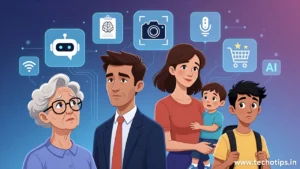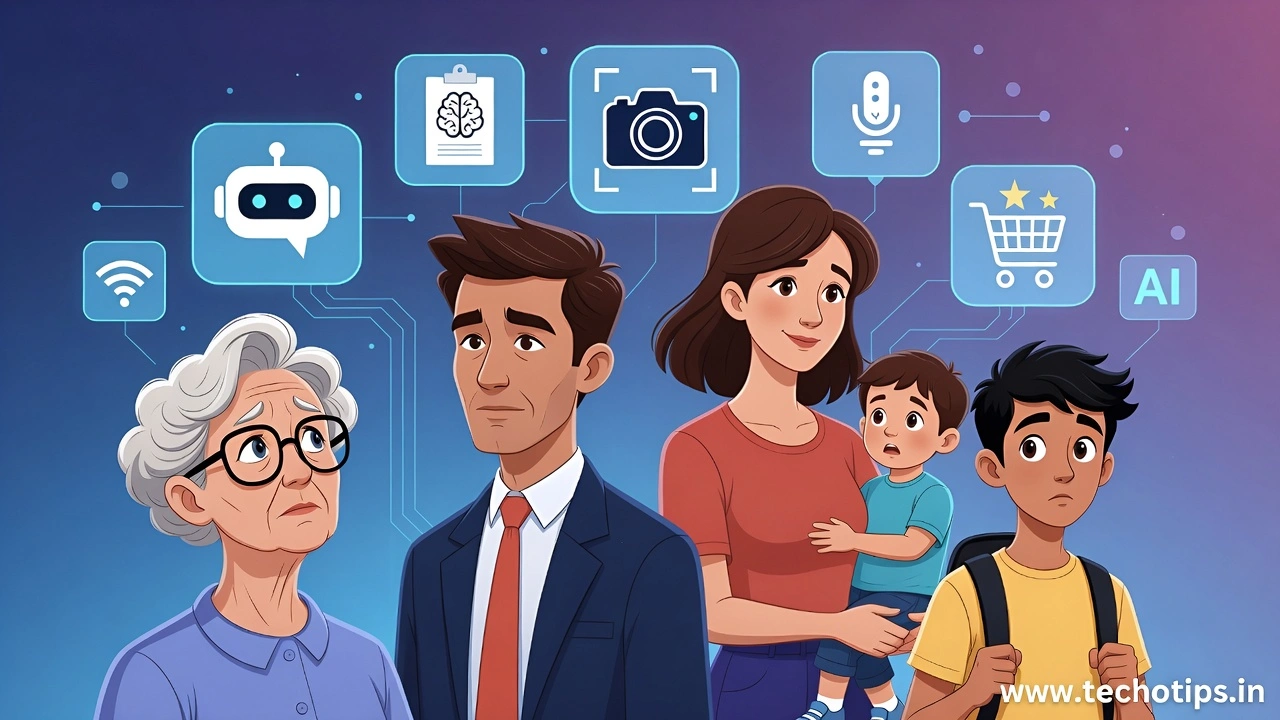
My 67-year-old father asked me last month why his phone suddenly started finishing his text messages for him. My neighbor’s daughter got rejected from three jobs because AI screened out her resume before any human saw it. My local grocery store replaced half its checkout staff with self-service kiosks that use AI to detect what you’re buying.
Understanding how AI is affecting common people isn’t about science fiction anymore. It’s about explaining to your parents why their bank now uses a chatbot instead of customer service reps, or figuring out why your job application disappeared into an automated system.
The gap between what tech companies say AI does and what regular people actually experience keeps growing. While headlines celebrate AI breakthroughs, everyday folks are quietly dealing with AI that doesn’t understand their accent on phone support, or algorithms deciding their creditworthiness without explanation.
After watching friends and family navigate these changes over the past year, I’ve learned which AI impacts actually matter to daily life and which are just tech industry hype. This guide breaks down the AI impact on daily life in terms anyone can understand, without the technical jargon.
What Is AI and Why It Suddenly Matters
Artificial intelligence means computers doing tasks that previously required human thinking, like understanding language, recognizing images, making decisions, or learning from experience.
Why AI feels sudden: AI research has existed for decades, but three things changed recently to make it affect common people directly.
First, smartphones gave everyone powerful computers in their pockets capable of running AI. Second, internet connections became fast enough to use cloud-based AI instantly. Third, companies like OpenAI made AI tools so easy that anyone can use them without technical knowledge.
The ChatGPT moment: When ChatGPT launched in November 2022, it reached 100 million users in two months. Suddenly regular people could have conversations with AI, get homework help, write emails, and create content. This brought AI from labs into living rooms almost overnight.
Real shift for common people: Before 2023, AI mostly worked behind the scenes. Now it’s directly in your face when you call customer service, apply for jobs, use your phone’s camera, or search for information online.
How AI Is Affecting Common People in Everyday Situations
These are the ways artificial intelligence in everyday life shows up for regular people, not tech enthusiasts.
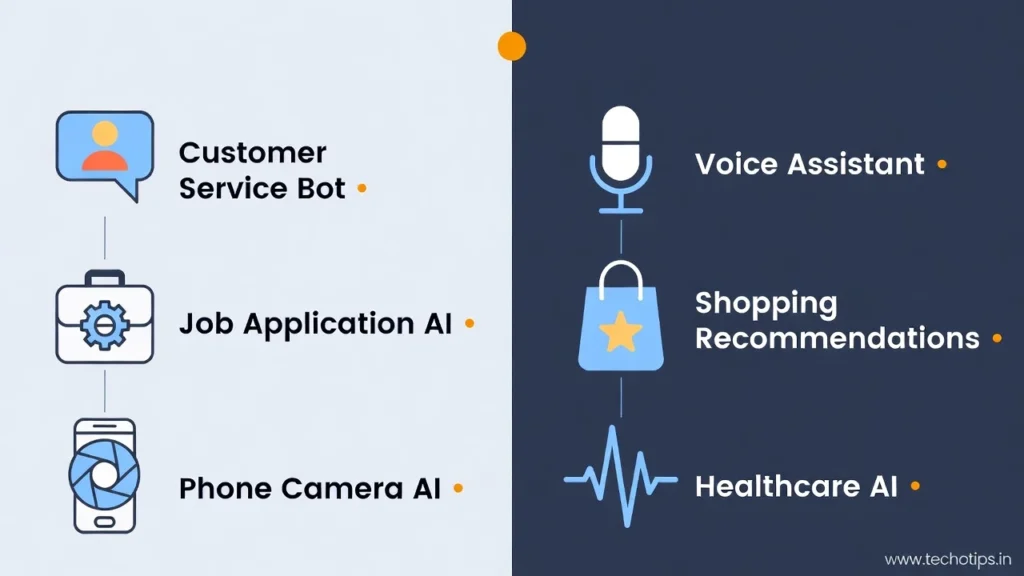
AI Customer Service Replacing Human Help
What’s happening: When you call your bank, internet provider, or insurance company, you’re increasingly talking to AI chatbots instead of people.
How it affects you:
Getting help for simple issues might be faster since AI responds instantly without wait times.
Complex problems become frustrating nightmares because AI doesn’t understand nuance or unusual situations.
The option to “speak to a human” is disappearing or hidden behind multiple AI interactions.
Real example: My mom spent 40 minutes trying to explain to her bank’s AI that she needed to dispute a charge. The AI kept giving generic responses about normal transactions until she gave up and went to a physical branch. The human representative fixed it in five minutes.
The pattern: AI customer service works great for common questions like “what’s my balance” or “reset my password.” But for anything outside its training, it fails badly while making you feel stupid for not asking the right way.
Read Also : Technology Trends That Affect Common People in the World
Job Applications Filtered by AI
The hidden impact: Your job application might never reach human eyes because AI systems screen resumes first.
How AI decides your fate:
Scans resumes for specific keywords matching the job description.
Filters out anyone with employment gaps, non-traditional education, or career changes.
Scores applications based on patterns from “successful” employees, which can include biased criteria.
Why this matters to common people: Someone with perfect qualifications but unconventional career path gets auto-rejected. A capable worker changing industries never gets a chance to explain why they’re switching fields.
My friend’s experience: After 50 job applications with zero responses, she discovered the AI systems were rejecting her because she took two years off to care for sick parents. The gap in employment triggered automatic disqualification before any recruiter saw her application.
The adaptation: People now use AI tools like ChatGPT to rewrite resumes with keywords that beat AI screening. It’s an AI arms race where everyone needs AI just to get past other AI.
AI Photo Editing in Your Phone
What changed: Your phone camera uses AI to automatically “improve” every photo you take, whether you asked for it or not.
The AI impact on daily life through photos:
Skin smoothing happens automatically, creating unrealistic beauty standards.
Background blur and lighting adjustments make amateur photos look professional.
AI removes photobombers, power lines, or unwanted objects from pictures.
Face detection and categorization organize your photos but raise privacy concerns.
The reality check: Photos you take aren’t “real” anymore. Your phone’s AI decides how you should look, often lightening skin tones or changing facial features in ways you might not notice.
Why it matters: Younger people grow up seeing AI-enhanced versions of themselves and others, affecting self-image and expectations. Older people might not realize their photos are being altered without consent.
AI Writing Assistance Everywhere
How this shows up: Gmail suggests how to finish your emails. Your phone predicts your next word. Apps like Grammarly rewrite your sentences.
The impact for common people:
Writing emails or documents becomes faster but more generic as everyone uses similar AI suggestions.
Students use ChatGPT for homework, changing what education means and making teachers unable to verify original work.
Job seekers use AI to write cover letters and applications, making it harder for employers to distinguish genuine candidates.
Communication changes: AI is homogenizing how people write. Everyone’s emails start sounding similar because they’re using the same AI suggestions.
Real concern: My nephew’s teacher can’t tell if he wrote his essay or if ChatGPT did. The school struggles with this because AI writing tools are free and accessible to every student.
AI Recommendations Controlling What You See
Behind the scenes: YouTube, Netflix, TikTok, Amazon, and social media use AI to decide what content you see next.
How AI is affecting common people through recommendations:
You exist in an AI-created bubble seeing content similar to what you previously liked.
Different people see completely different internet experiences based on their AI-curated feeds.
News and information you receive is filtered by algorithms, not chosen by you.
Shopping sites use AI to predict what you’ll buy and show personalized prices.
The manipulation factor: AI knows you better than you know yourself sometimes. It can predict when you’re vulnerable to impulse purchases or emotional content.
My experience: I searched for baby gifts once. For three months, every website showed me baby products and parenting ads despite having no children. The AI locked me into an incorrect assumption about my life.
AI Voice Assistants in Homes
The presence: Alexa, Google Assistant, Siri, and similar AI live in millions of homes, always listening for commands.
Daily life integration:
Setting timers, reminders, and alarms by voice instead of touching devices.
Controlling lights, thermostats, and appliances through voice commands.
Playing music, podcasts, or news on demand without searching.
Answering questions from cooking conversions to general knowledge.
Privacy trade-off: Having always-on microphones in your home listening to everything, with recordings sometimes reviewed by human workers.
The divide: Tech-comfortable people find voice assistants incredibly convenient. Others find them creepy, confusing, or frustrating when they misunderstand accents or names.
AI in Healthcare Affecting Access
What’s changing: AI helps diagnose diseases, reads X-rays, and triages patient symptoms before doctor appointments.
Impact on common people:
Some people get faster diagnoses as AI spots patterns in medical images that humans might miss.
Others face barriers when AI-powered scheduling systems or symptom checkers misunderstand their needs.
Rural areas gain access to AI diagnostic tools when specialist doctors aren’t available.
The concern: AI makes medical decisions without ability to consider full patient context, culture, or individual circumstances that human doctors would factor in.
AI Fraud and Scams Getting Smarter
The dark side: Scammers use AI to create convincing fake voices, videos, and messages.
New threats for common people:
AI-generated voice clones call pretending to be family members in emergency.
Deepfake videos show celebrities or politicians saying things they never said.
AI-written phishing emails sound more convincing and personalized than previous scams.
Real danger: My neighbor received a call from what sounded exactly like her grandson saying he was arrested and needed bail money. It was AI voice cloning. She almost sent $5,000 before calling her daughter to verify.
Protection difficulty: As AI gets better, common people can’t easily tell what’s real anymore. The old advice to “trust your eyes and ears” doesn’t work when AI can fake both perfectly.
AI Benefits for Common People
Despite challenges, artificial intelligence in everyday life brings real advantages worth acknowledging.

Making Information Accessible
How AI helps:
Instant answers to questions without searching through websites.
Explanations in simple language for complex topics.
Translation between languages in real-time through phone cameras or voice.
Real benefit: My grandmother who speaks limited English uses Google Translate’s camera feature to read medication labels and cooking instructions. This independence would be impossible without AI.
Read Also : How Can AI Be Used for Small Businesses?
Saving Time on Routine Tasks
Practical time savers:
AI scheduling assistants that find meeting times without email chains.
Smart email filtering that prioritizes important messages.
Automated photo organization and editing saving hours of manual work.
Voice-to-text that lets you write messages while doing other things.
Improving Accessibility
AI empowering people with disabilities:
Real-time captions for deaf or hard-of-hearing people on phone calls and videos.
Image description for blind users browsing the internet.
Voice control for people with limited mobility.
Meaningful impact: A friend with visual impairment now independently shops online using AI that describes products and reads reviews aloud. This wasn’t possible five years ago.
Personalized Learning
Education benefits:
AI tutors available 24/7 to explain concepts students don’t understand.
Practice problems that adapt to individual learning pace.
Language learning apps that adjust difficulty based on progress.
The upside: Students in schools without great teachers can access AI-powered learning that partially fills the gap.
AI Challenges for Common Users
The AI benefits for common people come with significant problems that disproportionately affect those less tech-savvy.
Loss of Human Connection
What we’re losing:
Customer service that understands unusual situations and makes compassionate exceptions.
Job interviews where you can explain your unique background to a person.
Healthcare providers who know your family and life context.
Emotional cost: Talking to AI when you’re frustrated, scared, or need help feels dehumanizing. Empathy matters, and AI can’t provide it genuinely.
AI Bias Affecting Real Lives
The problem: AI learns from existing data, which includes human biases. Then it amplifies those biases.
Real impacts:
Hiring AI favors candidates who look like previous employees, discriminating against women, minorities, or people with disabilities.
Credit scoring AI denies loans to people in certain zip codes or with certain names.
Criminal justice AI predicts higher risk for specific racial groups.
Why common people suffer: You get discriminated against by algorithms you can’t see or challenge, with no explanation or appeal process.
Privacy Erosion
What AI companies collect:
Your conversations with voice assistants.
Photos and videos you take with your phone.
Everything you search, watch, read, or buy online.
Your location history and movement patterns.
The bargain: You get “free” AI services by paying with your personal information, which gets sold and used in ways you don’t understand or agree to.
Digital Divide Getting Worse
The split: People with AI skills and access thrive. Those without fall further behind.
Who gets left out:
Elderly people uncomfortable with technology.
Low-income families without smartphones or internet.
Rural areas without broadband access.
People with disabilities that AI systems don’t accommodate.
Consequence: Essential services moving to AI-only options exclude millions of people who can’t or won’t adapt.
Job Displacement Fear
The worry: AI replacing human workers faster than new jobs are created.
Jobs already affected:
Customer service representatives replaced by chatbots.
Data entry and basic administrative work automated.
Taxi and delivery drivers threatened by autonomous vehicles.
Retail workers replaced by automated checkout and inventory systems.
The uncertainty: Nobody knows which jobs AI will eliminate next or if enough new jobs will be created to replace lost ones.
How Common People Can Navigate AI Changes
Adapting to how AI is affecting common people doesn’t require becoming a tech expert, just developing practical awareness.

Learn What AI Can and Can’t Do
Understand limitations:
AI doesn’t actually “think” or “understand” like humans do. It predicts patterns.
AI makes mistakes confidently, so always verify important information.
AI can’t consider context, emotions, or unique circumstances well.
Use this knowledge: Don’t trust AI blindly. Verify critical information through multiple sources, especially for health, finance, or legal matters.
Protect Your Privacy Actively
Practical steps:
Review and limit permissions for apps, especially microphone and camera access.
Use privacy-focused alternatives when possible (DuckDuckGo instead of Google).
Read privacy policies for AI services you use, at least the summary sections.
Opt out of data collection when options exist.
Realistic approach: You can’t avoid all AI tracking, but you can minimize it and understand what you’re trading for convenience.
Advocate for Human Options
Use your voice:
Request human customer service and refuse to give up easily.
Support businesses that maintain human staff alongside AI.
Contact representatives about laws requiring human alternatives for critical services.
Why it matters: Companies track customer complaints. Enough people demanding human options might slow the complete elimination of human workers.
Learn Enough to Avoid Scams
Basic AI awareness:
Videos and voices can be faked convincingly.
Verify unusual requests even if they seem to come from family.
Be suspicious of anything requiring urgent action or money transfer.
Protection habit: If something feels off, pause and verify through a different channel before acting.
Use AI Where It Helps, Ignore Where It Doesn’t
Smart adoption:
Use AI for routine tasks like scheduling, basic questions, or photo editing.
Insist on human help for complex problems, emotional support, or important decisions.
Don’t feel pressured: Just because AI exists doesn’t mean you must use it. Choose tools that genuinely improve your life.
The Future of AI and Common People
Understanding where this is heading helps you prepare rather than just react.
Next 2-3 years: AI will become more invisible, built into every app and service you use. You won’t always know when you’re interacting with AI.
Employment shift: More jobs will require AI skills as basic literacy. Not coding AI, but knowing how to use AI tools effectively.
Education change: Schools will struggle to adapt as AI makes traditional homework and testing obsolete. New forms of assessment will be needed.
Regulation probably: Governments will likely pass laws about AI transparency, bias, and privacy as problems become undeniable.
The hope: AI could improve lives significantly if deployed ethically with human welfare prioritized over profit. That’s not guaranteed though.
This connects to our broader discussion of technology trends that affect common people, where AI represents just one of many rapid changes impacting daily life.
Finding Balance With AI in Your Life
After a year of watching how AI is affecting common people around me, the pattern is clear: thoughtful adoption works better than either complete rejection or blind acceptance.
My approach now is selective. I use AI for tasks where it genuinely helps, like quick information lookup or photo organization. But I avoid it for anything requiring human judgment, empathy, or high stakes decisions.
The AI impact on daily life will only intensify. You can’t completely avoid it anymore. But you can choose how much you depend on it, understand its limitations, and maintain human connections wherever possible.
Remember that AI should serve you, not the other way around. If an AI tool makes your life harder instead of easier, you don’t have to use it just because everyone else does.
Stay informed, protect your privacy, verify important information, and never lose your healthy skepticism about technology that promises to solve everything.
Frequently Asked Questions
How is AI affecting common people’s jobs?
AI is automating routine tasks in customer service, data entry, basic writing, and administrative work, causing job displacement. However, it’s also creating demand for workers who can use AI tools effectively. Common people need to adapt by learning AI-adjacent skills or focusing on work requiring human creativity, empathy, and complex judgment that AI struggles with.
Is AI making life easier or harder for regular people?
Both. AI makes routine tasks faster (like photo editing, simple questions, scheduling) but creates new challenges like dealing with unhelpful chatbots, AI bias in hiring, and privacy concerns. The benefit depends largely on your comfort with technology and whether you have alternatives when AI fails.
Can I avoid AI completely in daily life?
Not really anymore. AI runs behind the scenes in your phone’s camera, email spam filters, social media feeds, online shopping recommendations, and banking fraud detection. You can minimize direct AI interaction by choosing human customer service and avoiding AI assistants, but complete avoidance is nearly impossible in 2026.
How do I know if I’m talking to AI or a human?
It’s getting harder to tell. Look for responses that seem scripted, don’t directly address your specific question, or provide generic answers. AI typically struggles with understanding emotional context, complex situations, or requests requiring judgment. If unsure, ask directly: “Am I speaking with a person or AI?”
What are the biggest risks of AI for common people?
Privacy erosion from constant data collection, job displacement without retraining opportunities, AI bias in important decisions like hiring and loans, scams using AI-generated fake voices or videos, and social isolation as human interaction gets replaced by AI. The digital divide also worsens as AI skills become necessary for basic services.
Should I let my kids use AI tools like ChatGPT?
With supervision and education, yes. AI tools are becoming essential skills for future employment. However, teach critical thinking—verify AI outputs, understand when human help is better, and ensure they learn without just copying AI answers. Set boundaries around what AI can be used for and monitor their dependence on it.
How can I protect myself from AI scams?
Verify unexpected requests independently (call the person back using a number you already have, don’t use numbers they provide). Be suspicious of urgent demands for money or information. Know that voices, videos, and images can be faked. Pause before acting on emotional manipulation. Enable two-factor authentication on important accounts.